
20ft vs 40ft Shipping Container: Which Size Is Right for You? (2026 Guide)
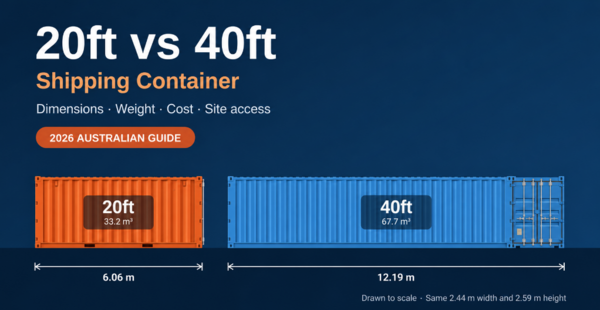
Quick answer: Choose a 20ft container (6.06 m long, 33.2 m³) if your site access is tight, your load is heavy or dense, or you need less than about 33 m³ of space. Choose a 40ft container (12.19 m long, 67.7 m³) if you need up to 67 m³, carry long or bulky items, and a truck can physically reach the spot. A 40ft holds twice the volume but costs less than double, so it only pays off if you can fill it and place it.
Key takeaways
- • A 40ft container is twice as long (12.19 m vs 6.06 m) and holds about double the volume (67.7 m³ vs 33.2 m³). Width (2.44 m) and height (2.59 m) are identical.
- • It costs less than double, but the premium varies. On one Australian retailer's price list, a used 40ft costs about 35% more than a used 20ft, while a new 40ft costs about 70% more.
- • A 20ft can carry more weight (about 28,200 kg payload vs 26,700 kg at the common 30,480 kg rating) because it weighs less empty.
- • Site access decides more purchases than price. A 40ft needs roughly double the ground space and often a side loader or crane truck.
- • Two 20ft containers beat one 40ft when you need separation, two door openings, storage in two places or a staged spend.
This guide covers both buyers and hirers of storage containers in Australia, and importers and exporters moving freight. Where the answer differs, each section says so.
20ft vs 40ft container: specifications at a glance
A standard 20ft shipping container transport measures 6.06 m × 2.44 m × 2.59 m externally and holds about 33.2 m³. A standard 40ft container measures 12.19 m × 2.44 m × 2.59 m externally and holds about 67.7 m³. Both are built to the ISO 668 standard, which is why they fit any compliant truck, ship or crane.
|
Specification |
20ft container |
40ft container |
|
External size (L × W × H) |
6.06 × 2.44 × 2.59 m |
12.19 × 2.44 × 2.59 m |
|
Internal size (L × W × H) |
5.90 × 2.35 × 2.39 m |
12.03 × 2.35 × 2.39 m |
|
Door opening (W × H) |
2.34 × 2.28 m |
2.34 × 2.28 m |
|
Internal volume |
≈ 33.2 m³ |
≈ 67.7 m³ |
|
Internal floor area |
≈ 13.9 m² |
≈ 28.3 m² |
|
Tare (empty) weight |
≈ 2,200–2,300 kg |
≈ 3,750–3,800 kg |
|
Maximum gross weight* |
30,480 kg |
30,480 kg |
|
Maximum payload |
≈ 28,200 kg |
≈ 26,700 kg |
|
Australian standard pallets (1.165 × 1.165 m), single layer |
10 |
20 |
|
Standard 1.2 × 1.0 m pallets, single layer |
10–11 |
22–24 |
|
Freight unit |
1 TEU |
2 TEU (1 FEU) |
Many older 20ft units carry a lower 24,000 kg rating. Always read the CSC safety approval plate on the door of the specific container you are buying, hiring or shipping. Dimensions also vary by a few centimetres between manufacturers.
20ft and 40ft container dimensions
The only dimension that changes between the two sizes is length. A 40ft container is roughly the length of two 20ft containers placed end to end, so it doubles the volume and floor area while keeping the same width, height and door size.
That identical door opening matters more than most people expect. A 40ft container has one doorway and 12 metres of depth behind it, so reaching items at the back means unloading everything in front. Two 20ft containers give you two openings and far easier access to the whole volume.
High cube containers: 20ft vs 40ft
A high cube (HC) container is 0.30 m taller than a standard one: 2.90 m externally and about 2.70 m internally. That lifts volume to roughly 37 m³ for a 20ft high cube and 76 m³ for a 40ft high cube. High cubes suit racking, fit-outs where the ceiling will come down once lined, offices and workshops where people stand inside, and refrigerated units. The footprint is unchanged, but check overhead clearance on the delivery route, because the unit is taller on the truck.
Weight and payload: which container carries more?
A 20ft container can carry slightly more weight than a 40ft container, even though it is half the size. Payload is the maximum gross weight minus the tare (empty) weight. At the common 30,480 kg rating, a 20ft's payload is about 28,200 kg and a 40ft's is about 26,700 kg, because the longer frame is heavier.
This leads to a simple rule about cargo density:
|
20ft container |
40ft container |
|
|
Payload at 30,480 kg rating |
≈ 28,200 kg |
≈ 26,700 kg |
|
Internal volume |
33.2 m³ |
67.7 m³ |
|
Weight becomes the limit above |
≈ 850 kg/m³ |
≈ 395 kg/m³ |
If your cargo is denser than about 400 kg per cubic metre, a 40ft reaches its weight limit before it is full. Steel, tiles, pavers, stone, bagged cement and machinery are typically denser than that, so they usually suit a 20ft. Lighter, bulkier cargo such as furniture, textiles, flat-pack goods and packaging fills a 40ft by volume first.
Road limits, not the container, often set the real ceiling
The container's rated payload is rarely what a truck can legally carry on the road. In Australia, a packed container moved by heavy vehicle needs a container weight declaration (CWD): a written statement of the weight of the container and its contents, supplied by the consignor before the trip starts. Under Chain of Responsibility rules, consignors, packers and loaders share responsibility for preventing mass breaches. Containers that have been modified so they are no longer fit for multimodal transport, or are no longer primarily used to move freight, are treated differently, so confirm with your carrier.
For international freight, the shipper must also provide a verified gross mass (VGM) before a container can be loaded on a vessel, a requirement under the SOLAS convention since 1 July 2016.
20ft vs 40ft container cost: is a 40ft double the price?
No. A 40ft container costs noticeably less than double a 20ft, but the gap is not a fixed percentage. It depends on whether you buy used or new, and on how much of the space you will use.
Published Australian price points show the pattern:
|
Price point (AUD) |
20ft |
40ft |
40ft premium |
|
Used (CBOX, via Canstar) |
$2,590 |
$3,490 |
+35% |
|
New (CBOX, via Canstar) |
$3,990 |
$6,790 |
+70% |
|
Used, cargo-worthy, market range (Inside Retail, 2025) |
$2,000–$4,000 |
$3,500–$5,500 (high cube) |
n/a |
|
New, market range (Inside Retail, 2025) |
$4,000–$6,000 |
$6,500–$8,500 (high cube) |
n/a |
Indicative figures from published Australian listings. Confirm GST, delivery, grade and current availability with your supplier.
Cost per cubic metre: where the 40ft wins
Divide each price by internal volume and the 40ft is cheaper per cubic metre in both cases.
- • Used: about $78 per m³ for a 20ft vs $52 per m³ for a 40ft (34% cheaper per m³).
- • New: about $120 per m³ for a 20ft vs $100 per m³ for a 40ft (17% cheaper per m³).
The saving is real, but it only counts if you fill the extra space and can place the unit. Many projects use only part of a 40ft, which means paying for space you never use.
Freight costs follow the same pattern
For import and export, ocean freight rates also scale less than linearly. One Australian freight forwarder illustrates a 20ft at about AUD $2,500 and a 40ft at about AUD $3,200 on an Asia-to-Australia route, which is 28% more for double the space, or roughly $75 vs $47 per m³. Rates move constantly, so treat this as an illustration and get a current quote. If your shipment is under about 30 m³, a 20ft is usually more economical. Above roughly 35 m³, a 40ft usually wins.
The costs people forget
- • Delivery: one 40ft is one delivery, while two 20fts are two deliveries. A 40ft may also need a side loader or crane, which costs more than a standard tilt-tray.
- • Site preparation: both need firm, level ground, but a 40ft spans more of it, so uneven ground matters more.
- • Relocation: moving a 40ft later is a bigger, more expensive job with fewer capable trucks.
- • Resale: the second-hand market for 20fts is typically deeper, because almost any site can take one.
Delivery and site access: will a 40ft container fit?
A 40ft container needs about twice the ground space of a 20ft, and delivery access is where many 40ft purchases fail. The unit's footprint is only part of it: the truck needs room to arrive, turn and place it.
|
Delivery method |
Typically suits |
What it needs |
|
Tilt-tray truck |
20ft on open or straight sites |
A long, straight, level run-in behind the placement spot (around 20 m for a 20ft, more for a 40ft) |
|
Side loader |
40ft and 20ft with roadside access |
Room for the truck to stand beside the spot; the container is set down to one side, so the side matters |
|
Crane or hiab truck |
Tight, fenced or awkward sites |
Overhead clearance, firm ground for the outriggers, and a higher delivery price |
Always confirm exact requirements with your carrier, because they vary by truck and operator.
Before you order
- 1. Peg out the footprint. A 40ft is 12.19 m × 2.44 m. Mark it on the ground with pegs and string, add about 2.5 m clear in front of the doors, then stand back.
- 2. Walk the route as if you were the truck. Check gate width, the turn off the street, the straight run behind the spot, and overhead lines or branches.
- 3. Check the rules. Council, body corporate and planning requirements for placing a container vary by location and by how long it will stay, so check with your local council before ordering.
- 4. Send photos. A good supplier can often tell from three photos (road looking in, spot looking out, wide shot of the spot) whether a unit will fit.
Best use cases: 20ft vs 40ft by project
Match the size to the job rather than to the idea that bigger is better value.
|
Project |
Usually best |
Why |
|
Backyard or home storage |
20ft (or 10ft) |
Fits residential access; easier to place and resell |
|
Tools and materials on a building site |
20ft |
Easy to move between jobs; handles heavy loads |
|
Site office, crib room or workshop |
20ft, high cube for headroom |
Compact; the extra 0.30 m of height makes a fit-out comfortable |
|
Farm machinery, feed and chemicals |
20ft, or two 20fts |
Separation of feed, chemicals and tools; two openings |
|
Container home, studio or accommodation |
40ft high cube |
About 28 m² of floor area and the most internal height |
|
Long items over 5.9 m (timber, pipe, roofing, kayaks) |
40ft |
A 20ft physically cannot hold them |
|
Import or export of light, bulky goods (furniture, textiles) |
40ft |
Fills by volume; lower cost per m³ |
|
Import or export of dense goods (tiles, steel, stone, machinery) |
20ft |
Reaches the weight limit before the volume limit |
When two 20ft containers beat one 40ft
Choose two 20ft containers when:
- The site cannot take a 40ft. This is the most common reason, and on its own it settles the question.
- • You want separation. Keep clean gear apart from dirty, or chemicals apart from feed, without building an internal wall.
- • You want two door ends. Two openings give far better access than one doorway at the end of a 12 m tunnel.
- • You want storage in two places, such as one at the house and one at the block.
- • You want to stage the spend. Buy one now and a second later.
- • You may sell one later. It is easier to sell one 20ft than half of a 40ft.
Choose one 40ft container when:
- • Items are longer than 5.9 m. This decides it outright.
- • You need close to 67 m³ of volume. Two 20fts cost more, need two deliveries and give you two sets of doors to secure.
- • The site has room. Wide gateways, hardstand and no overhead lines remove the access objection and keep the cost-per-m³ advantage.
- • One footprint is better than two. A single long unit along a boundary can be less intrusive than two boxes in the middle of a yard.
Shipping and freight: what changes for importers and exporters?
In international freight, a 20ft container is one TEU (twenty-foot equivalent unit) and a 40ft is two TEU, also called one FEU (forty-foot equivalent unit). The same trade-off applies: more volume per dollar in a 40ft, more weight per container in a 20ft.
Three freight-specific points matter:
- • FCL vs LCL. A full container load (FCL) means you book the whole container, which reduces handling and damage risk. Less than container load (LCL) means sharing space with other shippers, which is cheaper for small volumes but slower. If your goods would fill less than about 15 m³, LCL is worth quoting.
- • Weight versus volume. Check your cargo density using the 400 kg/m³ rule above before choosing a 40ft.
- • Compliance on the road leg. After the ship, the container still travels by road in Australia, so a container weight declaration is required for the final delivery.
How to choose between a 20ft and 40ft container: four questions
Work through these in order. Price comes last because it is the easiest factor to fix and the least likely to be the one you regret.
- 1. Is your longest item over 5.9 m? If yes, you need a 40ft.
- 2. Can a truck physically reach the spot and place 12 m of container? If not, choose a 20ft (or a 10ft if the gap is very tight).
- 3. Do you need more than about 33 m³ (roughly 10 pallets)? If not, a 20ft is enough and costs less.
- 4. Is the load dense (over about 400 kg/m³), or do you need separate zones or two door ends? If yes, choose two 20fts. If not, choose one 40ft, in high cube if the cargo is tall.
Don't forget the 10ft and the high cube
The choice is not binary. A 10ft container suits a mower, compressor and hand tools, fits through gaps a 20ft cannot, and keeps the yard usable. It costs more per cubic metre, which is worth paying when the alternative does not fit. At the other end, a high cube adds 0.30 m of internal height for a modest premium and no extra footprint.
FAQ: 20ft vs 40ft shipping containers
What is the difference between a 20ft and a 40ft shipping container?
The difference is length. A 20ft container is 6.06 m long with about 33.2 m³ of internal volume, and a 40ft is 12.19 m long with about 67.7 m³. Both are 2.44 m wide and 2.59 m high externally, and both have the same 2.34 × 2.28 m door opening.
Is a 40ft container twice the price of a 20ft?
No. A 40ft usually costs less than double. On one Australian retailer's price points, a used 40ft costs about 35% more than a used 20ft and a new 40ft about 70% more. Ocean freight for a 40ft is typically a smaller premium again. Confirm current prices with your supplier.
How many pallets fit in a 20ft and a 40ft container?
A 20ft container fits about 10 Australian standard pallets (1.165 × 1.165 m) in a single layer, or 10–11 standard 1.2 × 1.0 m pallets. A 40ft fits about 20 Australian pallets, or 22–24 standard pallets. Loading patterns and pallet overhang change the exact count.
Which can carry more weight, a 20ft or a 40ft container?
At the common 30,480 kg gross rating, a 20ft has a payload of about 28,200 kg and a 40ft about 26,700 kg, because the 40ft is heavier empty. In practice, road mass limits and the container's CSC plate rating set the real limit, so check both before loading.
Can a 40ft container be delivered to a residential property?
Sometimes, but many suburban blocks cannot take one. A 40ft needs a wide access point, a clear turn, a level placement area and often a side loader or crane truck instead of a tilt-tray. Measure the access, mark out 12.19 m on the ground, and confirm with your carrier before ordering.
Is it cheaper to buy one 40ft or two 20ft containers?
One 40ft is usually cheaper than two 20fts of the same grade, and needs only one delivery. However, two 20fts can be better value when the site cannot take a 40ft, when you need separation or two door openings, or when you may want to sell one later.
What do TEU and FEU mean?
TEU means twenty-foot equivalent unit, the standard measure of container capacity: one 20ft container equals one TEU. FEU means forty-foot equivalent unit: one 40ft container equals one FEU, or two TEU. Shipping lines and ports use these units to measure vessel capacity and price freight.
Do I need council approval to place a shipping container on my property?
It depends on your local council, your state's planning rules and how the container will be used. Permanent placement, proximity to boundaries, and use as an office or dwelling are more likely to need approval. Check with your local council before ordering.
Conclusion: pick the size your site and cargo can actually use
The 20ft vs 40ft decision comes down to four things in this order: the length of your longest item, whether a truck can reach and place the container, how much volume you really need, and how dense your load is. Price matters, but a 40ft's lower cost per cubic metre only helps if you fill the space and can deliver it.
If you are still unsure, send us three photos of your site and a list of what is going in, and we will tell you what will physically fit.
Sources and further reading
- • ISO 668:2020, Series 1 freight containers (classification, dimensions and ratings): https://www.iso.org/standard/76912.html
- • National Heavy Vehicle Regulator (NHVR), "Container weight declarations": https://www.nhvr.gov.au/safety-accreditation-compliance/on-road-compliance-and-enforcement/container-weight-declarations
- • Canstar, "Buying a shipping container": https://www.canstar.com.au/personal-loans/shipping-container-cost/
- • Inside Retail, "What current shipping container prices mean for Australian retailers in 2025": https://insideretail.com.au/business/what-current-shipping-container-prices-mean-for-australian-retailers-in-2025-202511
- • Synergy Freight Management, "Understanding Container Freight: 20ft vs 40ft Shipping": https://www.synergyfreight.com.au/blog/container-freight/
- • International Maritime Organization, "Verification of the gross mass of a packed container": https://imo.org/en/OurWork/Safety/Pages/Verification-of-the-gross-mass.aspx